Products

This site uses cookies to make the site run smoothly and power functions such as the enquiry basket. We use third-party performance cookies to store anonymised information on how you use our site in order to improve your experience. You may accept or decline these cookies. You can also manage your choices via our Customise Cookies page.





![Images [4gtr+Bass] product illustration](https://www.spanishguitar.com/images/prod32_do634.jpg)
![This Moment [Soprano] product illustration](https://www.spanishguitar.com/images/prod57_do635.jpg)

![Rondena [Iberia] (Gruber-Maklar) product illustration](https://www.spanishguitar.com/images/prod42_do560.jpg)
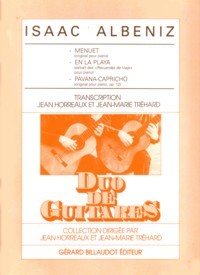


![En la Playa, op.71/7(Burden) [GM3] product illustration](https://www.spanishguitar.com/images/prod40_gm03.jpg)













![Hypnose [TR-DESC] product illustration](https://www.spanishguitar.com/images/prod47_EF3119.jpg)

![Divertissement, op.46 [Vn/Va/Vc/Gtr] product illustration](https://www.spanishguitar.com/images/prod22_spes22.jpg)

![En valsant [4/5Gtrs] product illustration](https://www.spanishguitar.com/images/prod24_hl27061.jpg)



![Quartett I [Rec/Va Gmba/Perc/Gtr] product illustration](https://www.spanishguitar.com/images/prod46_de07408.jpg)

![Primer Concierto [Gtr part] product illustration](https://www.spanishguitar.com/images/prod08_vf1150.jpg)


![Suite in g-min (Schaller) [TR] product illustration](https://www.spanishguitar.com/images/prod35_JPA02.jpg)
![Vidalita (Fernandez-Lavie) [med voc] product illustration](https://www.spanishguitar.com/images/prod25_me6781.jpg)
![Suite in g-min (Schaller) [TR] product illustration](https://www.spanishguitar.com/images/prod56_jpa06.jpg)
![Suite in F (Schaller) [TR] product illustration](https://www.spanishguitar.com/images/prod37_jpa07.jpg)
![Greensleeves to a Ground(Schaller) [DESC] product illustration](https://www.spanishguitar.com/images/prod32_gkm081.jpg)
![Suite in d-min (Schaller) [TR] product illustration](https://www.spanishguitar.com/images/prod43_jpa08.jpg)
![6 Seguidillas Boleras [Med Voc] product illustration](https://www.spanishguitar.com/images/prod44_gl155.jpg)
![Studie, op.29 [Fl/Va/Gtr] product illustration](https://www.spanishguitar.com/images/prod03_gkm109.jpg)